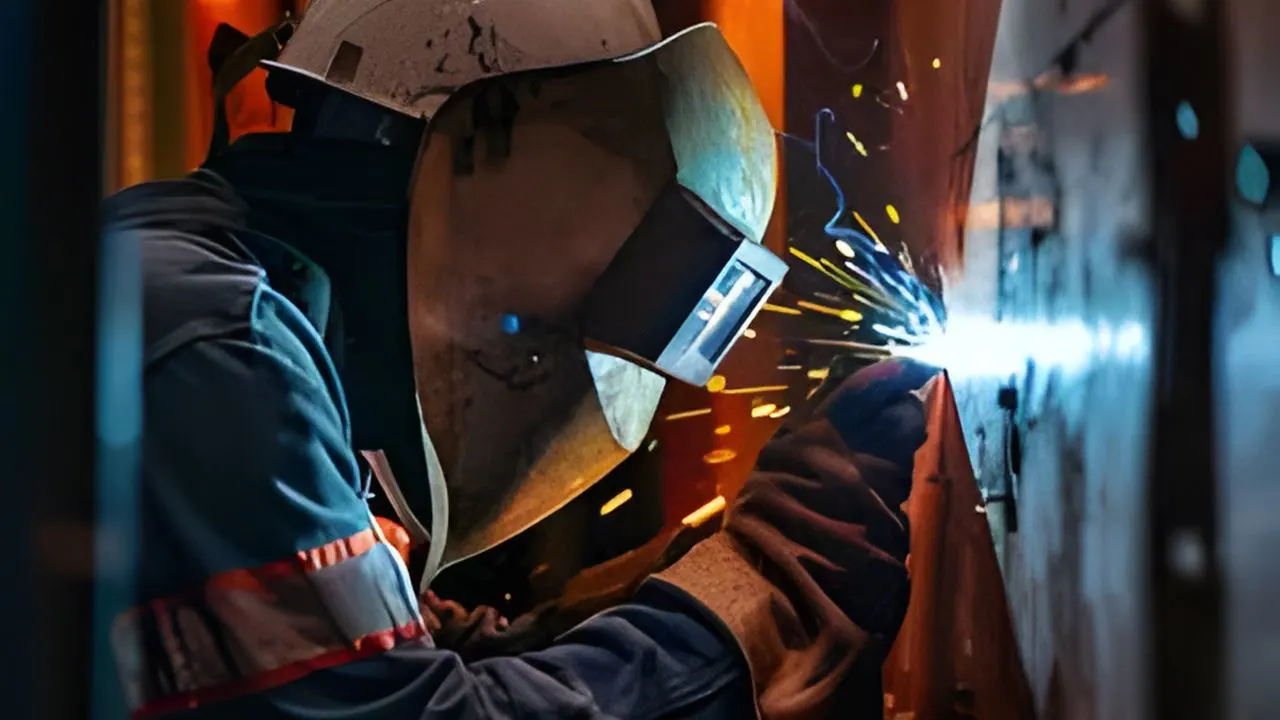
Welding is a basic process in manufacturing, construction, and metal fabrication industries. It involves joining two or more metal pieces by applying heat, pressure, or both, to create a strong bond. Ensuring high-quality welds requires not only proper technique but also Welding and Welder Performance Tests. At ITE Noida, we specialize in training and guidance on welding Procedure, offering practical solutions that enhance skills and safety for industry workers.
What Are the 4 Types of Welding
There are many welding processes available, but four techniques are widely used across industries due to their efficiency, versatility, and reliability.
1. Shielded Metal Arc Welding (SMAW)
Shielded Metal Arc Welding (SMAW) is one of the most commonly used welding techniques. It involves using a consumable electrode coated in flux to create an electric arc between the electrode and the metal. The heat melts the metals, forming a strong bond.
When to use:
- SMAW is ideal for construction, repair work, and pipeline welding.
- It works well for welding thick materials like steel and iron.
- It is suitable for outdoor welding due to its tolerance for wind and weather.
Advantages:
- Portable and cost-effective.
- Minimal equipment required.
- Can weld various metals with proper electrodes.
2. Gas Metal Arc Welding (GMAW / MIG)
Gas Metal Arc Welding (GMAW), commonly called MIG (Metal Inert Gas) welding, uses a continuous wire electrode fed through a welding gun. Shielding gas is used to protect the weld from contamination.
When to use:
- Ideal for industrial manufacturing, automotive work, and fabrication.
- Works best for thin to medium-thick metals.
- Excellent for achieving clean, high-quality welds with minimal post-weld cleaning.
Advantages:
- High welding speed and efficiency.
- Produces smooth, consistent welds.
- Easier to learn compared to other welding methods.
3. Gas Tungsten Arc Welding (GTAW / TIG)
Gas Tungsten Arc Welding (GTAW), also known as TIG welding, uses a non-consumable tungsten electrode to create the weld. A separate filler metal may be used, and inert gas (like argon) protects the weld pool.
When to use:
- Ideal for precision welding of thin materials such as stainless steel, aluminum, and copper.
- Used in aerospace, automotive, and high-quality fabrication work.
- Suitable for decorative welding or critical joints requiring clean welds.
Advantages:
- Produces precise and clean welds.
- Works on a wide variety of metals.
- Offers excellent control over the welding process.
4. Flux-Cored Arc Welding (FCAW)
Flux-Cored Arc Welding (FCAW) is similar to MIG welding but uses a tubular wire filled with flux. It can be used with or without external shielding gas, depending on the wire type.
When to use:
- Suitable for heavy fabrication, construction, and shipbuilding.
- Effective for outdoor applications where wind can affect gas-shielded welding.
- Ideal for thick metal sections requiring deep penetration.
Advantages:
- High deposition rates for faster welding.
- Can handle thicker materials than MIG welding.
- Portable and versatile for fieldwork.
How Many Types of Welding
There are many specialized welding processes, these four represent the main types of welding used across industries. Other types, such as submerged arc welding, resistance welding, and laser welding, are also important but are more niche or automated. For most industrial and fabrication needs, SMAW, GMAW, GTAW, and FCAW cover the majority of applications. At ITE Noida, we offer hands-on training and theoretical knowledge on all these welding methods to ensure workers gain confidence and skill.
Types of performance tests:
- Destructive testing (bending, tensile, and impact tests)
- Non-destructive testing (ultrasonic, radiographic, and dye-penetrant tests)
- Visual inspection for weld uniformity, penetration, and defects
At ITE Noida, we offer comprehensive training programs that include performance testing, ensuring welders are certified and industry-ready. This approach enhances workforce efficiency, reduces rework, and improves overall project quality.
Also Read : Post Weld Heat Treatment: Procedures, Types & Alternatives
Why Choose ITE Noida
ITE Noida is committed to delivering high-quality education and hands-on experience in welding. We not only teach the main types of welding but also ensure that our trainees understand practical applications and safety procedures. Our programs offer:
- Expert guidance from experienced professionals.
- Access to modern welding equipment and training facilities.
- Comprehensive understanding of all major welding processes.
- Preparation for Welding and Welder Performance Tests for certifications.
Welding is a critical process in modern industry, and understanding the main types of welding is essential for quality, efficiency, and safety. The four key welding procedures—SMAW, GMAW, GTAW, and FCAW each have their unique applications, advantages, and limitations. ITE Noida provides high-quality welded products, skilled welders, and reliable performance. Our focus on hands-on training, modern techniques, and performance testing ensures that every welder is equipped to meet industry demands while maintaining the highest standards.