
Ultrasonic Testing (UT) is one of the most widely used due to its accuracy, depth penetration, and versatility. Understanding the ultrasonic testing procedure and choosing the right ultrasonic testing equipment are vital steps in achieving accurate and consistent results. ITE Noida, a trusted name in testing and inspection technology, continues to offer modern ultrasonic testing machines and professional training services. Their advanced systems and expertise make ultrasonic testing reliable, efficient, and suitable for a wide range of industrial applications.
Ultrasonic testing (UT) is a non-destructive testing method that uses high-frequency sound waves to detect internal flaws in materials. This reflection is analyzed to determine the presence, size, and location of the flaw. The high sensitivity and precision of ultrasonic testing make it ideal for evaluating metals, plastics, and ceramics across industries like aerospace, manufacturing, oil & gas, construction, and automotive. At ITE Noida provides reliable ultrasonic testing equipment designed to deliver accurate and repeatable results even in complex inspection environments.
Ultrasonic Testing Equipment
The core of ultrasonic testing procedure lies in the quality and accuracy of the testing instruments. The ultrasonic testing equipment typically includes the following components:
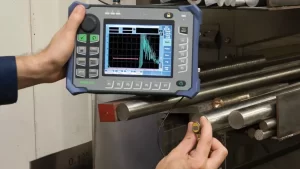
- Ultrasonic Testing Machine: This is the main unit used to generate, receive, and display ultrasonic signals. It converts electrical energy into ultrasonic pulses and measures the reflected waves from the test material.
- Transducer (Probe): The transducer is a key component that converts electrical pulses into mechanical vibrations and vice versa. Different types of probes: such as straight beam, angle beam, and immersion probes are used based on the testing requirement.
- Couplant: A gel or liquid used between the probe and the test surface to eliminate air gaps and allow smooth transmission of ultrasonic waves.
- Display Screen: The testing machine displays the reflected signals, which indicate the depth and size of any internal flaws.
ITE Noida provides advanced ultrasonic testing machines that ensure clear and accurate signal interpretation. Their machines come with digital displays, data recording features, and portable designs to support field and laboratory applications.
Also Read : WPS and WPQR: specification and qualification of welding procedures
Ultrasonic Testing Procedure
The ultrasonic testing procedure follows a systematic approach to ensure accurate results and repeatability. Below are the general steps involved:
- Surface Preparation: Before conducting a ut test, the surface of the specimen is cleaned and smoothed to remove dirt, rust, or paint that may affect wave transmission.
- Equipment Setup: The ultrasonic testing machine are measured using reference blocks with known flaw sizes or thicknesses to ensure measurement accuracy.
- Application of Couplant: A couplant is applied to the test surface to ensure efficient transmission of ultrasonic waves from the probe into the material.
- Scanning the Surface: The technician moves the transducer over the surface. The ultrasonic test equipment emits high-frequency sound waves into the material, and reflected signals are displayed on the screen.
- Signal Interpretation: By analyzing the reflected signals, technicians can identify internal flaws such as cracks, inclusions, porosity, or voids. The size of each defect is determined based on the time delay and amplitude of the reflections.
- Recording and Reporting: The results are recorded, and a detailed inspection report is prepared that includes findings, calibration data, and interpretations.
ITE Noida offers complete ultrasonic testing services and guidance. Their equipment is built to ensure that every ut test produces accurate, reliable, and repeatable data.
Applications of Ultrasonic Testing
Ultrasonic testing is widely used across different industries for multiple applications:
- Weld Inspection: Detecting cracks, lack of fusion, or porosity in welded joints.
- Thickness Measurement: Determining the thickness of pipes, tanks, and pressure vessels.
- Casting Inspection: Identifying internal voids or shrinkage defects.
- Composite Material Testing: Checking for delamination or voids in aerospace and automotive parts.
- Corrosion Detection: Measuring remaining wall thickness in corroded components.
ITE Noida stands out as a reliable and innovative leader in this field. We continuously provide advanced ultrasonic testing machines and complete support solutions for different industrial applications. Whether it’s weld inspection, thickness measurement, or flaw detection, their systems deliver precise and consistent results. We ensure that every ut test meets the highest quality standards. Their commitment to excellence helps industries maintain safety, efficiency, and performance making them a trusted partner for all ultrasonic test equipment and testing needs.