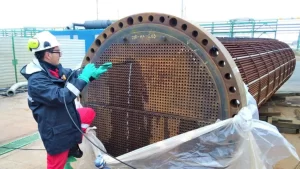
ITE Noida has been at the forefront of advanced non-destructive testing (NDT) technologies, and one of the most reliable methods we provide is Remote-Field Testing (RFT). This powerful inspection technique is widely used for examining metallic tubes, pipelines, and heat-exchanger components in industries such as power plants, chemical facilities, oil refineries, and water treatment plants. Understanding remote field testing is essential for ensuring structural integrity, safety, and long-term equipment performance.
Remote-Field Testing
Remote field testing is a non-destructive method that uses low-frequency electromagnetic fields to detect flaws in metal tubes. Unlike traditional methods, the unique characteristic of this technique is that the electromagnetic field travels outside the tube wall and re-enters at a remote location, making it highly sensitive to internal and external defects.
How Remote-Field Eddy Current Testing Works
It is important to look at remote field eddy current testing in detail. When the transmitter coil energizes the tube, a magnetic field passes through the tube wall, moves to the outer region, and then travels back into the tube at a remote point. This is why the technique is called “remote-field.”
The receiver coil detects the returning field and measures its strength and stage shift. Any changes in the tube wall such as corrosion or cracks will cause variations in the magnetic field. These variations help inspectors understand the condition of the tube.
Key Components Used in RFT Testing
- Transmitter Coil: Generates the magnetic field that passes through the tube wall.
- Receiver Coil: Placed at a remote distance to detect the returning field.
- Probe Housing: Protects coils and electronics while moving through tubes.
- Signal Analyzer: Used to interpret phase and amplitude changes.
These elements make rft testing a reliable technique for inspecting heat exchanger tubes, boiler tubes, and pipelines.
Advantages of Remote Field Testing
- Suitable for Ferromagnetic Materials: While traditional eddy current testing struggles with carbon steel or iron-based tubes, remote field eddy current technology works exceptionally well with these materials.
- Detects Internal and External Flaws: Because the field travels outside the tube wall, RFT can detect both inner and outer defects with high accuracy.
- Deep Penetration Capability: The method offers better depth penetration, making rft inspection ideal for thick-walled pipes.
- High Sensitivity: Even small levels of wall thinning or pitting can be detected.
- Reliable for Long Tubes: RFT is perfect for industries that use long pipelines, such as power stations and refineries.
Applications of RFT Testing
Industries that rely heavily on metal tubes benefit greatly from remote field testing, including:
- Power plants
- Petrochemical industries
- Oil and gas refineries
- HVAC systems
- Water treatment plants
- Boiler and heat exchanger manufacturers
These industries depend on rft inspection to ensure safety, prevent downtime, and maintain efficiency.
Also Read : Preheating in Welding: When and Why Is It Necessary?
Why Remote Field Eddy Current Testing is Important
The ability to detect corrosion before it leads to leakage or failure makes remote field eddy current testing extremely valuable. Regular inspection reduces repair costs, prevents operational downtime, and increases the lifespan of plant equipment. In environments where safety is crucial, such as boilers or chemical processing plants, early detection can prevent major accidents.
Remote-Field Testing (RFT) is an advanced, reliable, and efficient NDT method for inspecting ferromagnetic tubes and pipelines. Its deep penetration, sensitivity to internal/external defects, and suitability for carbon steel make it a preferred choice across industries. With their commitment to excellence, ITE Noida continues to provide world-class remote field eddy current testing services that help industries maintain safety, performance, and reliability.