At ITE Noida, we provide advanced testing services that help manufacturers, engineers, and quality professionals evaluate material performance accurately. Through proper mechanical testing, organizations can ensure compliance with industry standards, improve product quality, and reduce the risk of failures in real-world applications.
Whether it is a metal component used in construction, a plastic part in an automobile, or a composite material in aerospace applications, every product must perform as expected under various operating conditions. This is where mechanical testing plays a vital role.
What Is Mechanical Testing?
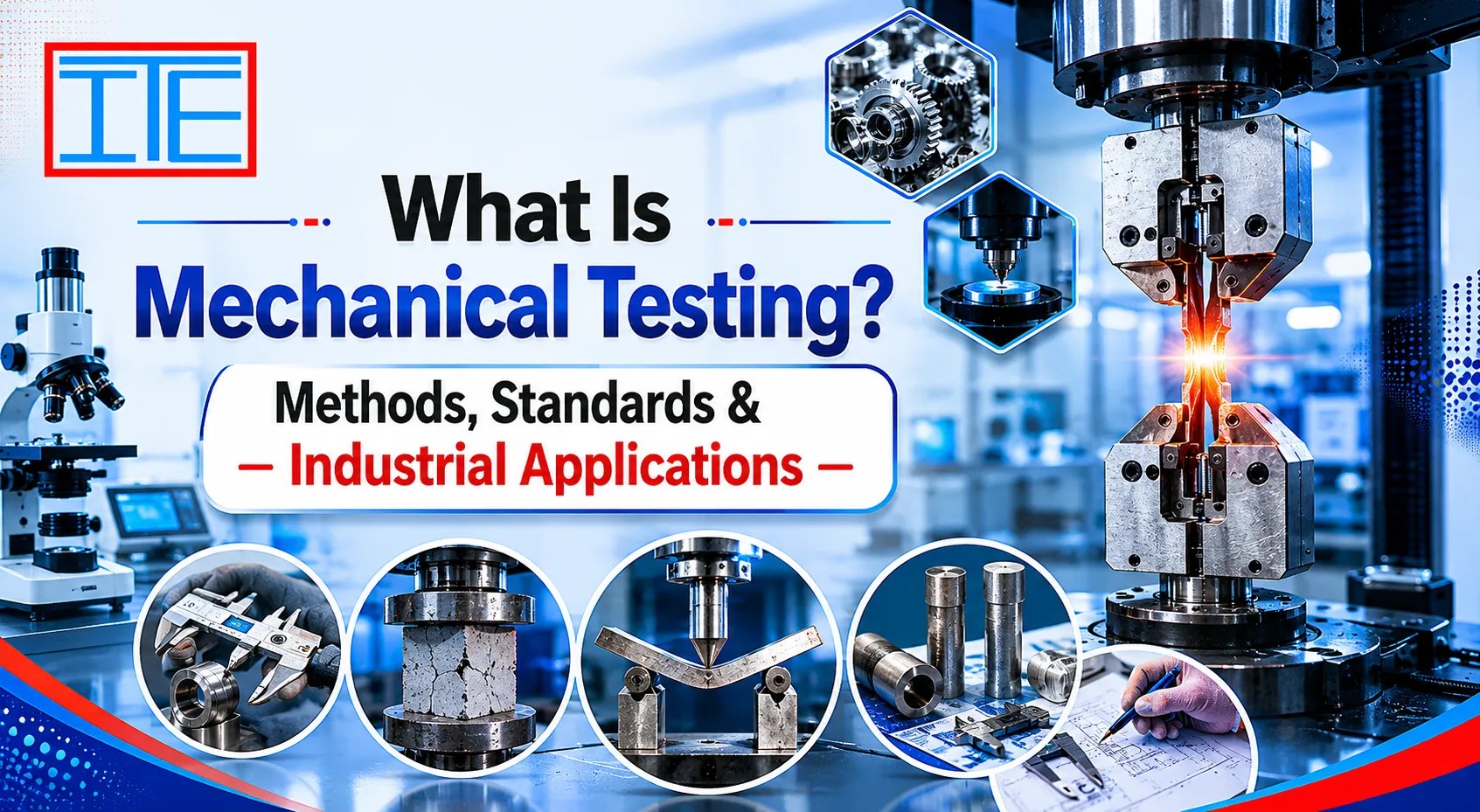
Mechanical Testing is the process of evaluating the physical and mechanical properties of materials by applying controlled forces or loads. These tests help determine how a material behaves under different conditions such as tension, compression, bending, impact, and fatigue.
The primary objective of mechanical testing is to assess a material’s strength, durability, elasticity, toughness, and resistance to failure.
Why Is Mechanical Testing Important?
Modern industries rely on mechanical testing to maintain product quality and ensure safety. Even minor material defects can lead to costly failures, equipment damage, or safety hazards.
Key benefits of mechanical testing include:
- Verification of material quality
- Compliance with industry standards
- Improved product reliability
- Enhanced customer confidence
- Reduced manufacturing defects
- Better material selection
- Increased operational safety
At ITE Noida, we offer comprehensive testing solutions that support quality assurance programs across various industries.
Common Mechanical Testing Methods
Different materials and applications require different testing techniques. Below are some of the most widely used mechanical testing methods.
1. Tensile Testing
Tensile testing measures how a material reacts when subjected to pulling forces. During the test, a sample is stretched until it breaks. Tensile testing is commonly used for metals, plastics, composites, and rubber products.
2. Compression Testing
Compression testing evaluates a material’s behavior when subjected to crushing or compressive loads. Compression testing helps determine load-bearing capacity and structural performance.
3. Hardness Testing
Hardness testing measures a material’s resistance to indentation, scratching, or wear. Hardness values provide valuable information about material strength and durability.
4. Impact Testing
Impact testing evaluates a material’s ability to absorb energy during sudden loading conditions. Impact testing is especially important for materials used in dynamic or low-temperature environments.
5. Bend Testing
Bend testing assesses a material’s flexibility and resistance to cracking when subjected to bending forces.
6. Fatigue Testing
Fatigue testing determines how a material performs under repeated cyclic loading over time. Industries such as aerospace and automotive heavily rely on fatigue testing.
7. Torsion Testing
Torsion testing measures a material’s ability to withstand twisting forces.
8. Creep Testing
Creep testing evaluates how materials deform under constant load and elevated temperature over extended periods.
This testing method is essential for power plants, turbines, and high-temperature industrial equipment.
Mechanical Testing Standards
To ensure consistency and reliability, mechanical testing procedures are conducted according to internationally recognized standards.
- ASTM Standards: The ASTM International standards provide detailed procedures for various testing methods and are widely followed across industries worldwide.
- ISO Standards: The International Organization for Standardization (ISO) establishes global testing guidelines to ensure uniformity and quality assurance.
- BIS Standards: In India, the Bureau of Indian Standards (BIS) provides testing specifications and quality requirements for numerous materials and products.
- ASME Standards: The American Society of Mechanical Engineers (ASME) develops standards for mechanical components and industrial equipment.
Following these standards ensures test accuracy, repeatability, and regulatory compliance.
Industrial Applications of Mechanical Testing
- Automotive Industry: The automotive industry relies heavily on mechanical testing to ensure the safety, durability, and performance of vehicle components.
- Aerospace Industry: In the aerospace sector, mechanical testing is essential for evaluating aircraft structures, turbine blades, fasteners, and composite materials.
- Construction and Infrastructure: Construction companies use mechanical testing to assess the quality of steel, concrete, welds, and structural materials.
- Manufacturing and Industrial Equipment: Manufacturers perform mechanical testing to verify product quality and material performance before products reach the market.
Why Choose ITE Noida?
At ITE Noida, we offer professional mechanical testing services using advanced equipment and internationally accepted testing procedures. Our experienced team supports industries with accurate, reliable, and timely testing solutions.
Our services help clients:
- Maintain product quality
- Meet regulatory requirements
- Improve material performance
- Enhance safety standards
- Support research and development activities
We are committed to delivering testing excellence that helps organizations make informed engineering decisions.
Mechanical testing is an essential process for evaluating material strength, durability, reliability, and overall performance. From tensile and compression testing to fatigue and impact analysis, these methods help industries ensure product quality and operational safety.
By following recognized standards and utilizing advanced testing techniques, manufacturers can minimize failures, improve performance, and meet customer expectations. At ITE Noida, we offer comprehensive mechanical testing services that support quality assurance, product development, and industrial compliance across a wide range of sectors.