
ITE Noida is a trusted name in the field of Non-Destructive Testing (NDT), providing comprehensive inspection solutions that guarantee precision and performance. Our company’s expertise, advanced technology, and commitment to quality make it a reliable partner for industries that prioritize safety and structural soundness. Our focus is offering precise NDT tests that help clients maintain safety, improve quality control, and prevent costly failures.
What is Non-Destructive Testing (NDT)?
Non-Destructive Testing (NDT) refers to a range of analysis techniques used to evaluate the properties of materials, components, or structures without causing any damage. Unlike destructive testing, where samples are broken or altered to assess their strength, NDT testing allows inspection without affecting the usability of the product. This makes NDT particularly valuable in industries such as aerospace, automotive, construction, power generation, oil and gas, and manufacturing, where components must perform reliably under various conditions.
Importance of NDT Testing
The importance of non destructive testing lies in its ability to detect flaws, cracks, corrosion, or irregularities at an early stage—before they develop into critical problems. Using advanced non destructive testing methods, engineers can identify issues without dismantling structures or halting production processes.
Some key benefits include:
- Safety Assurance: Detects hidden defects that could lead to accidents or breakdowns.
- Cost Savings: Reduces repair and replacement costs by identifying problems early.
- Quality Control: Ensures that materials and components meet design and regulatory standards.
- Efficiency: Minimizes downtime during inspection, keeping operations running smoothly.
- Data Accuracy: Provides reliable information for maintenance planning and product improvement.
ITE Noida helps clients achieve superior quality assurance and maintain compliance with international standards.
Also Read: Top 10 Most Widely Used Standards in Tensile Testing
Types and Techniques of NDT
There are various non destructive testing methods, each designed to detect specific types of flaws and defects. ITE Noida uses advanced instruments and expert techniques to perform different NDT tests, ensuring accurate and reliable results. Below are some of the most common NDT testing methods:
- Visual Inspection (VT): This is the most basic form of NDT test, involving careful visual examination of the surface to detect cracks, corrosion, or deformities. Using magnifying tools, mirrors, or borescopes, inspectors can identify visible defects effectively.
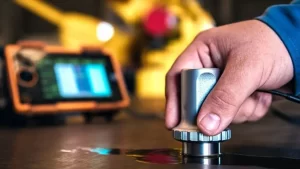
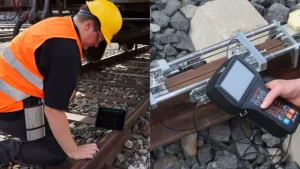
- Ultrasonic Testing (UT): Ultrasonic testing uses high-frequency sound waves to detect internal flaws. The waves travel through the material and reflect back from imperfections. ITE Noida uses advanced ultrasonic instruments to provide highly accurate internal analysis of materials.
- Radiographic Testing (RT): In radiographic testing, X-rays or gamma rays are used to inspect the internal structure of a component. Variations in density appear as contrast on a radiographic image, indicating potential defects. This non destructive testing method is widely used for welds, castings, and pressure vessels.
- Magnetic Particle Testing (MT): This method is applicable for detecting surface and near-surface flaws in ferromagnetic materials. The part is magnetized, and magnetic particles are applied to its surface. If a defect is present, the particles accumulate at the discontinuity, revealing its location.
- Dye Penetrant Testing (PT): Dye penetrant testing involves applying a visible or fluorescent dye on the surface of non-porous materials. After a short period, excess dye is removed, and a developer is applied to draw out the penetrant from defects, making them visible. It’s one of the most effective non destructive testing methods for surface flaw detection.
- Eddy Current Testing (ECT): In eddy current testing, electromagnetic induction is used to detect surface and sub-surface defects in conductive materials. It’s a quick and reliable technique that requires minimal surface preparation.
- Acoustic Emission Testing (AE): This technique listens for high-frequency sound waves emitted from materials under stress. These emissions indicate the presence of cracks developing in real-time, allowing for continuous monitoring of structural integrity.
Each of these NDT testing techniques offers unique advantages, and ITE Noida ensures the most suitable method is selected based on the client’s specific material and inspection needs.
Applications of NDT Testing
Non destructive testing plays a crucial role across multiple industries. Some key applications include:
- Aerospace: Ensuring the safety of aircraft components and engines.
- Oil & Gas: Monitoring pipelines, tanks, and pressure vessels for corrosion or cracking.
- Construction: Testing welds, concrete, and steel structures for structural integrity.
- Power Generation: Inspecting turbines, boilers, and reactors to prevent equipment failure.
- Automotive: Evaluating engine parts, frames, and safety-critical components.
ITE Noida offers customized NDT tests for all these sectors, ensuring compliance, quality, and operational safety.
Non-Destructive Testing (NDT) is a vital tool in ensuring product quality, safety, and reliability. Through advanced non destructive testing methods, industries can detect flaws early, prevent costly failures, and maintain operational excellence. ITE Noida, with its dedication to accuracy and innovation, continues to lead the way by offering world-class NDT testing solutions. From ultrasonic to radiographic and magnetic particle methods, the company ensures thorough inspection and dependable results. When it comes to maintaining quality and safety standards, ITE Noida remains a name industries can trust ensuring that every product tested stands strong, safe, and reliable.